Generation 42
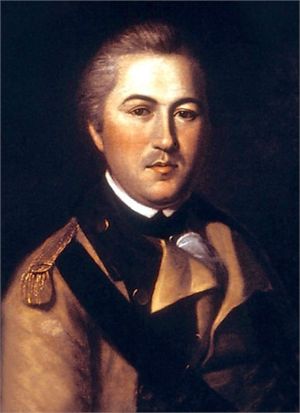
General Henry Lee
HUSBAND Major General Henry (Lighthorse Harry) LEE
Born 19 Jan 1756 in Dumfries; Prince William; VA
Married 18 Jun 1793 in Stratford Hall; Westmoreland; VA
Died 25 Mar 1818 in Cumberland Island; Camden; GA
Burial
Father Henry LEE
Mother Lucy Ludwell GRYMES
WIFE Ann Hill CARTER
Born Oct 1773 in Shirley Plantation; James River; VA
Died 26 Jul 1829 in Ravensworth Plantation; Fairfax; VA
Burial
Father
Mother
CHILDREN
1 Male Algeron Sidney LEE
Born 1795 in VA
Married in
Died 1796 in VA
Burial
Spouse
2 Male Charles Carter LEE
Born 1798 in VA
Married in
Died in
Burial
Spouse
3 Female Anne Kinloch LEE
Born 1800 in VA
Married in
Died in
Burial
Spouse
4 Male Sidney Smith LEE
Born 1802 in VA
Married in
Died in
Burial
Spouse
5 Male General Robert Edward LEE
Born 19 Jan 1807 in Stratford Hall; Westmoreland; VA
Married in
Died 12 Oct 1870 in Lexington; Albemarle; VA
Burial Lee Chapel Museum - Lexington; Albemarle; VA
Spouse Mary Ann CUSTIS
6 Female Catherine Mildred LEE
Born 27 Feb 1811 in
Married 1831 in
Died 1856 in Paris; France
Burial
Spouse Edward Vernon CHILDE
NOTES
Henry Lee was born near Dumfries, Virginia on the 29th of Jan 1756. The home was a plantation with over 200 slaves later called Stratford Hall Plantation. His great-grandmother Mary Bland was a great-aunt of President Thomas Jefferson and he descended once from King John of England, twice from King Edward I of England, once from King Jean de Brienne of Jerusalem, twice from King Edward III of England and once from King Pedro I of Castile. With a view to a legal career, he graduated (1773) from The College of New Jersey (now Princeton University), but, soon afterwards, on the outbreak of the Revolutionary War, he became a general in the revolutionary forces. In 1776, he was promoted to captain of a Virginia dragoon detachment, which was attached to the 1st Continental Light Dragoons; and, in 1778, he was promoted to major and given the command of a small irregular corps, with which he won a great reputation as a leader of light troops. From the start Lee drew attention for his coolness and for a certain dash that set him apart as an officer. He took noticeable trouble to care for his men and horses, spending a good deal of his personal wealth outfitting his troops. Lee used his men as special forces, scouting, harassing the enemy, and conducting some critical foraging for the bleak winter encampments at Morristown and Valley Forge. The small horse corps was so agile that Lee gained the nickname "Light-Horse Harry". His greatest exploit was the brilliant surprise at the Battle of Paulus Hook in New Jersey, on August 19, 1779; for this feat he received a gold medal, a reward given to no other officer below a general's rank in the entire war. He was promoted to lieutenant colonel with a picked corps of dragoons (Lee's Legion) to the southern theater of war. Here he rendered invaluable services in victory and defeat, notably at Guilford Court House, Camden and Eutaw Springs. He was present at Cornwallis's surrender at Yorktown, and afterwards left the army owing to ill health. During the infamous Whiskey Rebellion, Lee commanded the 13,000 militiamen sent to quash the rebels. However, this command existed more on paper than in actuality, as President George Washington and Alexander Hamilton, military men both, accompanied him.
He married his second-cousin, Matilda Ludwell Lee (1766–1790), who was known as "The Divine Matilda". Matilda was the daughter of Hon. Philip Ludwell Lee, Sr., Esq. Matilda's mother later married Philip Richard Fendall I, Esq. (1734–1805). Philip would eventually marry three wives, all Lee women. Thus, he was a cousin, brother-in-law, and stepfather-in-law to Light Horse Harry Lee.
On 13 June 1793, Henry Lee married the wealthy Anne Hill Carter (17 years his junior) at Shirley Plantation. They had six children, one of whom died in infancy in 1796. Their fifth child, Robert Edward Lee would later gain fame as a Confederate general during the American Civil War.
Unfortunately for Lee and his family, he invested large sums in numerous, highly speculative schemes, including partnerships with Aaron Burr and merchant Robert Morris. Although financial speculation was not rare among the Founding Fathers, Lee's handling of his personal finances was notably incompetent, and subjected his family to financial hardship. In 1810, to meet the demands of his creditors and be released from debtor’s prison, Lee was forced to sell all of his possessions. In 1785, he presented George Washington with twelve horse chestnut saplings as a token of friendship. Washington later gave two of these to his friend and aide, General Robert Brown. Washington planted his ten saplings on his estate at Mt. Vernon. Brown planted his two at his home in Bath, Pennsylvania, near East Allen Township; the sole surviving tree managed to last 136 years until lightning damaged it beyond repair in 1921. In 1928, 876 of its seeds were distributed to all of the 48 state universities at the time and various nations around the world. This symbol of outward friendship led to the recognition of Brown's Horse-chestnut as America's Friendship Tree.
From 1786 to 1788, Lee was a delegate to the Continental Congress, and in the last-named year in the Virginia convention, he favored the adoption of the United States Constitution. From 1789 to 1791, he served in the General Assembly and, from 1791 to 1794, was Governor of Virginia.
In 1794, Lee accompanied Washington to help in the suppression of the "Whiskey Rebellion" in western Pennsylvania. A new county of Virginia was named after him during his governorship. Henry Lee was a major general in the U.S. Army in 1798–1800. From 1799 to 1801, he served in the United States House of Representatives of the Congress. He wrote the famous phrase used by John Marshall in the address to Congress on the death of George Washington—"first in war, first in peace, and first in the hearts of his countrymen.".
On 27 July 1812, in Baltimore, while helping to resist the attack of a Democratic-Republican mob on his friend, Alexander Contee Hanson, editor of the Baltimore Federal Republican, which had opposed the War of 1812, Lee received grave injuries from which he never recovered.