TOWNLEY - a name born on the battlefield and baptized in the blood of a thousand French Knights

Flavious Marcianus Augustus "Marcian"; (392 - 27 Jan 457) - Emperor, Byzantine Empire; Theodosian Dynasty
Theodosian Dynasty was the Roman Imperial family that produced five Roman emperors during Late Antiquity; reigning over the Roman Empire from 379-457. The dynasty's patriarch Theodosius the Elder; whose son Theodosius the Great was made Roman Emperor in 379 and died on 28 Jul 450.
Marcian reversed many of the actions of Theodosius II in the Eastern Roman Empire's relationship with the Huns under Attila and in religious matters. Marcian almost immediately revoked all treaties with Attila, ending all subsidy payments to him. In 452, while Attila was raiding Italy, then a part of the Western Roman Empire, Marcian launched expeditions across the Danube into the Great Hungarian Plain, defeating the Huns in their own heartland. The Roman Empire ruled most of Europe and North Africa for hundreds of years. It was divided into two parts in 395. The Western half was ruled from Rome; and fell to tribal Germanic peoples known as barbarians in the 5th century. The Eastern half, known as the Byzantine Empire, lasted for more than 1,000 years. Until the mid-11th century, when it began to decline in power, the Byzantine Empire was one of the leading civilizations in the world. In 324 Constantine, the first Christian emperor, became sole ruler of the Roman Empire. He set up his Eastern headquarters at the ancient Greek colony of Byzantium in 330. The city, renamed Constantinople after its founder, was also known as the “new Rome.” It became the capital of the Byzantines after the Roman Empire was formally divided.
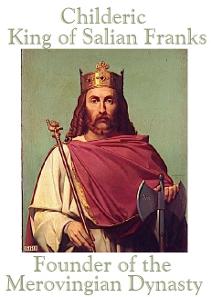
Childeric; King of Salian Franks; (437 - 481) Founder Merovingian Dynasty
Was a Frankish leader in the northern part of imperial Roman Gaul. Childeric's father is recorded to have been Merovech, whose name is the basis of the Merovingian dynasty. The Merovingian kingdom was created by a man named Childeric, governor of the Roman province of Belgica Secunda, who benefited from the demise of the Roman administrative system in Gaul in the third quarter of the fifth century and created a kingdom for himself. His rule is traditionally dated to 457-481. He was succeeded by his son Chlodovech ("Clovis"), who conquered most of France and expanded his power to the east. Although the Merovingians were of Frankish descent, their state was essentially a continuation of the Roman Empire.
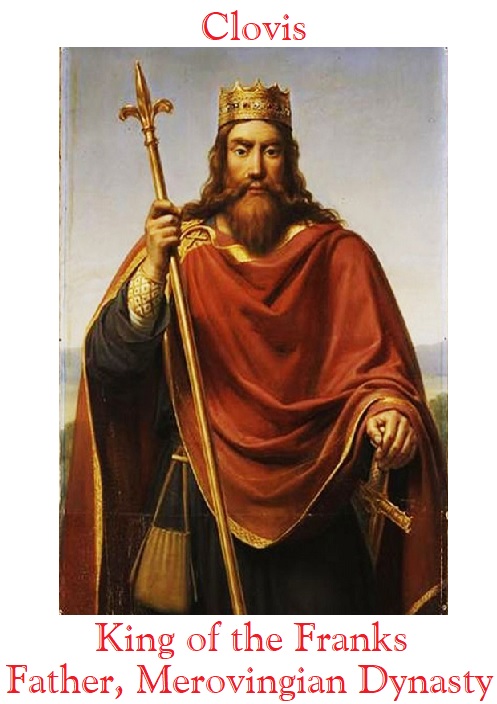
Clovis (466 - 511) King of the Franks, is considered the founding father of the Merovingian Dynasty, which would continue for over 200 years. Clovis became king at the age of 15 when his father Childric died. By the time of his death 30 years later, he had become the first king to rule over all the Frankish tribes, a firm ally of the Byzantine Empire, and a Christian king. Although raised a pagan (according to some historians, he would be the last of the pagan kings). Clovis realized that conversion to Christianity would be extremely beneficial to him if he ever hoped to secure the loyalty of all of the Frankish people. The queen unceasingly urged the king to acknowledge the true God, and forsake idols. But he could not in any wise be brought until war broke out with the Alamani … The two armies were in battle and there was great slaughter. Clovis' army was near to utter destruction. He… raised his eyes to heaven, saying … "If thou shalt grant me victory over these enemies… I will believe in thee and be baptized in thy name". Clovis was victorious and acknowledged the Christian god through baptism. Clovis was inspired by his newly found religious zeal to wage war against the Arian Visigoths which would be some of his most successful military campaigns. Clovis afterwards made war upon other people of Gaul and defeated them. At last, all the provinces from the lower Rhine to the Pyrenees Mountains were compelled to acknowledge him as king. He then went to reside at the city of Paris, which he made the capital of his kingdom. He died there A.D. 511. Clovis' name would live on through his dynasty, the Merovingians, and he is considered the founder of the modern nation of France. History would ultimately Latinize his name to Louis; a name that would live on in French royalty for centuries.
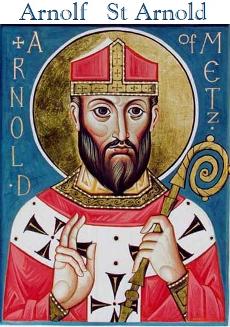
Arnolf also known as Saint Arnold (582 - 645) was a Frankish Bishop of Metz and advisor to the Merovingian court of Austrasia. Arnolf gave distinguished service at the Austrasian court under Theudebert II. He distinguished himself both as a military commander and in the civil administration; at one time he had under his care six distinct provinces. Arnolf was married in about 596 to a noblewoman named Dode (or Doda). Chlodulf of Metz was their oldest son, but more important is his second son Ansegisel, who married Begga daughter of Pepin I, Pepin of Landen. Arnolf is thus the male-line grandfather of Pepin of Herstal, great-grandfather of Charles Martel and great-great-great-grandfather of Charlemagne. During his career he was attracted to religious life, and around 628 he retired to a hermitage at a mountain site in his domains in the Vosges to become a monk. His friend Romaric, had preceded him to the mountains around 613. Arnolf settled near Habendum, where he died some time between 643 and 647. He was buried at Remiremont. Arnolf was canonized as a saint by the Roman Catholic Church. One legend associated with Arnolf is this: It was July 642 and very hot when the parishioners of Metz went to Remiremont to recover the remains of their former bishop. They had little to drink and the terrain was inhospitable. At the point when the exhausted procession was about to leave Champigneulles, one of the parishioners, Duc Notto, prayed "By his powerful intercession the Blessed Arnold will bring us what we lack." Immediately the small remnant of beer at the bottom of a pot multiplied in such amounts that the pilgrims' thirst was quenched and they had enough to enjoy the next evening when they arrived in Metz. For this reason he is known as the patron saint of Brewers.
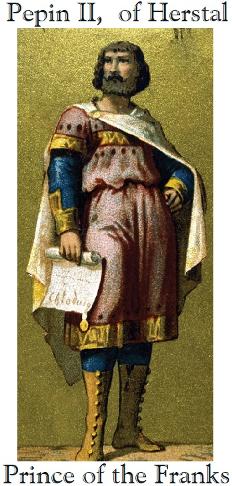
Pepin II (635 - 16 Dec 714) commonly known as Pepin of Herstal, was a Frankish statesman and military leader who de facto ruled Francia as the Mayor of the Palace from 680 until his death. He took the title Duke and Prince of the Franks upon his conquest of all the Frankish realms. The son of the powerful Frankish statesman Ansegisel, and grandson of Saint Arnold; Pepin worked to establish his family, the Pippinids, as the strongest in Francia. He became Mayor of the Palace in Austrasia in 680. Pepin subsequently embarked on several wars to expand his power. He united all the Frankish realms by the conquests of Neustria and Burgundy in 687. He was the grandson and namesake of Pepin I the Elder through the marriage of Pepin I's daughter Begga to Ansegisel. He was also the grandfather of Pepin the Short and great-grandfather of Charlemagne. That marriage united the two houses of the Pippinids and the Arnulfings which created what would be called the Carolingian dynasty. Pepin was created mayor in all three Frankish kingdoms (Austrasia, Neustria, and Burgundy) and began calling himself Duke and Prince of the Franks. Around 670, Pepin had married Plectrude, who had inherited substantial estates in the Moselle region. Pepin also had a mistress (or possibly, a second wife) named Alpaida (or Chalpaida) who bore him two more sons: Charles Martel and Childebrand. Pepin died suddenly at the age of 79 on 16 December 714, at Jupille (in modern Belgium)
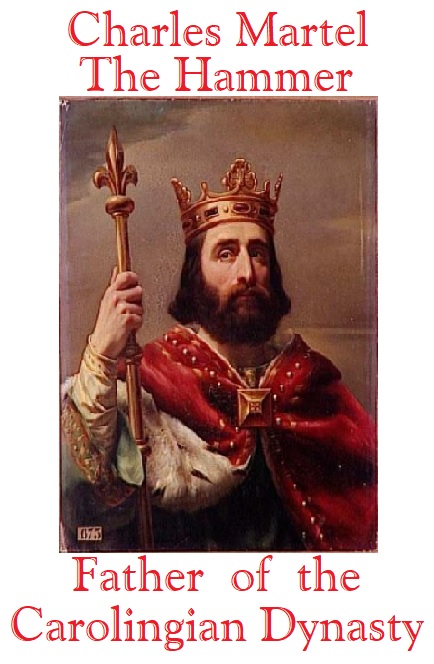
Charles Martel "The Hammer"; (23 Aug 686 - 15 Oct 741) Father of Carolingian Dynasty
He was a son of the Frankish statesman Pepin II of Herstal and Pepin's mistress, a noblewoman named Alpaida. A ruthless and successful warlord who played a pivotal role, as mayor of the palace (714–741), in the rise to royal and imperial rank of the Carolingian dynasty which carried his name. Continuing and building on his father's work, he restored centralized government in Francia and began the series of military campaigns that re-established the Franks as the undisputed masters of all Gaul. Charles and his successors earned much prestige by their campaigns against non-Christian groups (Muslims, Frisians, and Saxons) that combined military success with religious zeal. Traditionally, the greatest of Charles's military achievements was held to be his defeat of a Muslim army at Poitiers in October 732.
At the end of his reign, Charles divided Francia between his sons, Carloman and Pepin. The latter became the first king of the Carolingian dynasty. Pepin's son Charlemagne extended the Frankish realms and became the first emperor in the West since the fall of Rome.
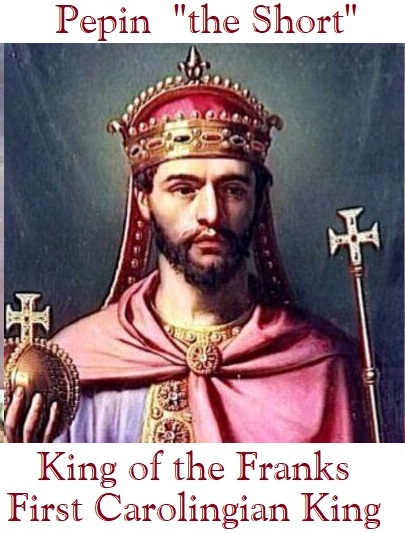
Pepin "the Short" (714 - 24 Sep 768) also called "the younger" was King of the Franks from 751 until his death in 768. He was the first Carolingian to become king. The younger son of the Frankish prince Charles Martel and his wife Rotrude, Pepin's upbringing was distinguished by the ecclesiastical education he had received from the monks of St. Denis. Succeeding his father as the Mayor of the Palace in 741, Pepin reigned over Francia jointly with his elder brother Carloman. In 743, they ended the Frankish interregnum by choosing Childeric III, who was to be the last Merovingian monarch, as figurehead king of the Franks. Being well disposed towards the church and papacy on account of their ecclesiastical upbringing, Pepin and Carloman continued their father's work in supporting Saint Boniface in reforming the Frankish Church, and evangelizing the Saxons. After Carloman, who was an intensely pious man, retired to religious life in 747, Pepin became the sole ruler of the Franks. As king, Pepin embarked on an ambitious program to expand his power. He reformed the legislation of the Franks and continued the ecclesiastical reforms of Boniface. He would be King of the first Carolingian Dynasty. Pepin died during a campaign, in 768 at the age of 54. He was interred in the Basilica of Saint Denis in modern-day Metropolitan Paris. His wife Bertrada was also interred there in 783. Charlemagne rebuilt the Basilica in honor of his parents and placed markers at the entrance. The Frankish realm was divided according to the Salic law between his two sons: Charlemagne and Carloman I. Although unquestionably one of the most powerful and successful rulers of his time, Pepin's reign is largely overshadowed by that of his more famous son, Charlemagne.
Charlemagne; (02 Apr 747 - 28 Jan 814) 1st Emperor Holy Roman Empire
Charlemagne; or Charles the Great; a member of the Carolingian dynasty, was King of the Franks from 768, King of the Lombards from 774, and the first Holy Roman Emperor from 800. Charlemagne succeeded in uniting the majority of western and central Europe and was the first recognized emperor to rule from western Europe after the fall of the Western Roman Empire around three centuries earlier. The expanded Frankish state that Charlemagne founded was the Carolingian Empire. Charlemagne was the eldest son of Pepin the Short and Bertrada of Laon. He was born before their canonical marriage. He became king of the Franks in 768 following his father's death, and was initially co-ruler with his brother Carloman I until the latter's death in 771. As sole ruler, he continued his father's policy towards protection of the papacy and became its sole defender. He reached the height of his power in 800 when he was crowned Emperor of the Romans by Pope Leo III on Christmas Day at Old St. Peter's Basilica in Rome. His reign spurred the Carolingian Renaissance, a period of energetic cultural and intellectual activity within the Western Church. Charlemagne died in 814 after contracting a fever. He was laid to rest in the Aachen Cathedral, in his imperial capital city of Aachen. He married at least four times, and several concubines. He had three legitimate sons who lived to adulthood. In all he had 18 children. Only the youngest of them, Louis the Pious, survived to succeed him. Charlemagne and his predecessors are the direct ancestors of many of Europe's royal houses, including the Capetian dynasty; the Ottonian dynasty; the House of Luxembourg; and the House of Ivrea.
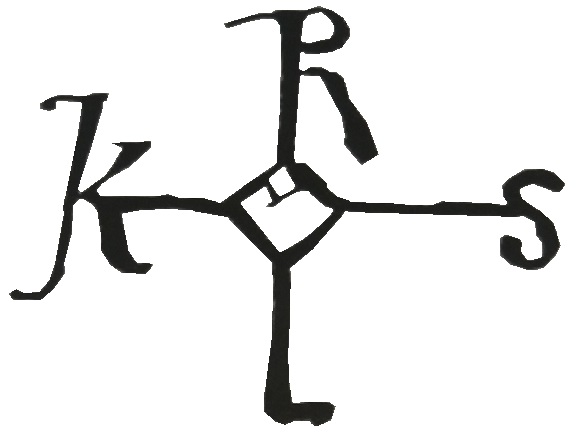
Left is an image of Charlemange's signature.
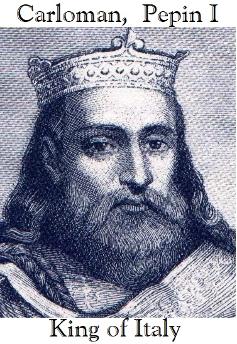
Carloman (Pepin I) 777 - 08 Jul 810) King of Italy - Carloman was the name he was given at birth in 777. He was named after his paternal uncle. He was the son of Charlemagne and Hildegarde Schwaben. Pepin (Peppinum) was the name he was given at his baptism by the Pope in 781. At his baptism he was made King of the Lombards at Pavia. Pepin was king of the Lombards (781-810) under the authority of his father. He was King of Italy, 781-810. He was active as ruler of Lombardy and worked to expand the Frankish empire. In 791, he marched a Lombard army into the Drava valley and ravaged Pannonia, while his father marched along the Danube into Avar territory. Charlemagne left the campaigning to deal with a Saxon revolt in 792. The Kingdom of Italy was one of the constituent kingdoms of the Holy Roman Empire. Carloman was at the height of his rein in 810; but a silent killer put him in his grave. He did not die in battle, or at the end of a sword; but rather the scourge of the Medieval world. The Black Death. He was only 37 years old but died from the silent killer that millions of people died from during that time; the bubonic plague. The bite from a flea from an infected rat brought this great warrior down. Multiple sources give Pepin's death as 08 July 810, and his place of burial as Mediolanum (modern Milan). He was buried at Verona, San Zeno.
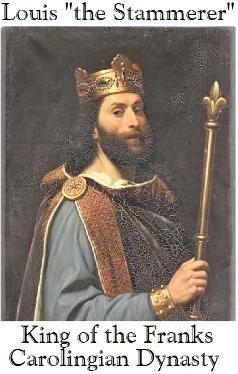
Louis II; (01 Nov 846 - 10 Apr 879) - also known as Louis the Stammerer; was the King of Aquitaine and later the King of West Francia. He was the eldest son of Emperor Charles the Bald and Ermentrude of Orléans. Louis the Stammerer was physically weak and outlived his father by a year and a half. Louis was crowned king on 8 October 877 by Hincmar, archbishop of Reims, at Compiegne. Louis had relatively little impact on politics. He was described "a simple and sweet man, a lover of peace, justice, and religion". His final act was to march against the invading Vikings, but he fell ill and died on 9 April or 10 April 879, not long after beginning this final campaign. On his death, his realms were divided between his two sons, Carloman II and Louis III of France.
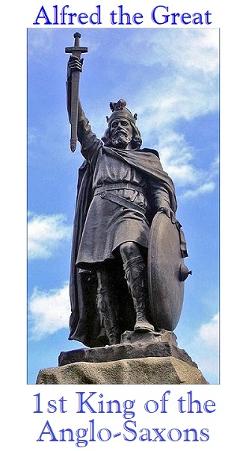
Alfred the Great - (848 - 26 Oct 899) was King of the West Saxons from 871 to 886 and King of the Anglo-Saxons from 886 until his death in 899. Under Alfred's rule, considerable administrative and military reforms were introduced, prompting lasting change in England. After ascending the throne, Alfred spent several years fighting Viking invasions. He won a decisive victory in the Battle of Edington in 878 and made an agreement with the Vikings, dividing England between Anglo-Saxon territory and the Viking-ruled Danelaw. Alfred had a reputation as a learned and merciful man of a gracious and level-headed nature who encouraged education, proposing that primary education be conducted in English, rather than Latin, and improving the legal system and military structure and his people's quality of life. He was given the epithet "the Great" in the 16th century. Alfred died on 26 October 899 at the age of 50 or 51. How he died is unknown, but he suffered throughout his life with a painful and unpleasant illness. His biographer Asser gave a detailed description of Alfred's symptoms. Modern doctors disgnose the symptons as either Crohn's disease or haemorrhoids.
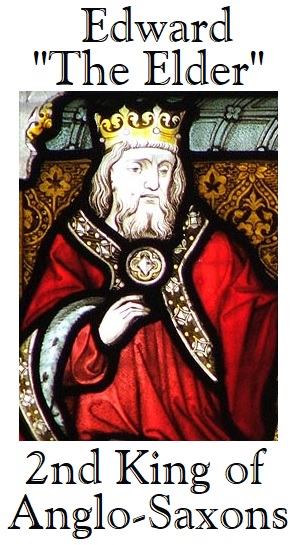
Edward "the Elder" (874 - 17 Jul 924) was King of the Anglo-Saxons from 899 until his death in 924. He was the elder son of Alfred the Great and his wife Ealhswith. As a son of a king, Edward was an ætheling, a prince of the royal house who was eligible for kingship. Once Edward grew up, Alfred was able to give him military commands and experience in royal administration. Alfred died on 26 October 899 and Edward succeeded to the throne, but Æthelwold disputed the succession. He seized the royal estates of Wimborne, symbolically important as the place where his father was buried, and Christchurch, both in Dorset. Edward marched with his army to the nearby Iron Age hillfort at Badbury Rings. Æthelwold declared that he would live or die at Wimborne, but then left in the night and rode to Northumbria, where the Danes accepted him as king. In London in 886 Alfred had received the formal submission of "all the English people that were not under subjection to the Danes" (King of the Anglo-Saxons). No battles are recorded between the Anglo-Saxons and the Danish Vikings for several years after the Battle of the Holme, but in 906 Edward agreed to peace with the East Anglian and Northumbrian Danes, suggesting that there had been conflict. In 911 Æthelred, Lord of the Mercians, died, and Edward took control of the Mercian lands around London and Oxford. Edward and Æthelflæd then began the construction of fortresses to guard against Viking attacks and protect territory captured from them. In November 911, he constructed a fort on the north bank of the River Lea at Hertford to guard against attack by the Danes of Bedford and Cambridge. In 912, he marched with his army to Maldon in Essex, and ordered the building of a fort at Witham and a second fort at Hertford, which protected London from attack and encouraged many English living under Danish rule in Essex to submit to him. Edward was "much inferior to his father in the cultivation of letters", but "incomparably more glorious in the power of his rule". He died at the royal estate of Farndon, twelve miles south of Chester, on 17 July 924, shortly after putting down a revolt, and was buried in the New Minster, Winchester.
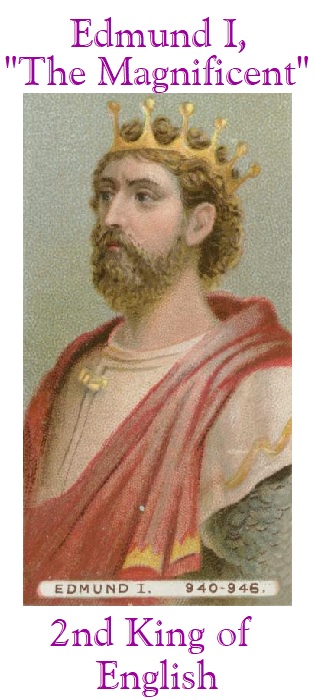
Edmund "the Magnificent" (920 - 26 May 946) was King of the English from 27 October 939 until his death on 26 May 946. He was the elder son of King Edward the Elder and his third wife, Queen Eadgifu, and a grandson of King Alfred the Great. Edmund had one or two full sisters. Eadburh was a nun at Winchester who was later venerated as a saint. Edmund probably married his first wife Ælfgifu around the time of his accession to the throne, as their second son was born in 943. Their sons Eadwig and Edgar both became kings of England. Ælfgifu was also a benefactor of Shaftesbury Abbey; when she died in 944 she was buried there and venerated as a saint. On 26 May 946 Edmund was killed in a brawl at Pucklechurch in Gloucestershire. Historians more likely suggest, that the king was the victim of a political assassination. Like his son Edgar thirty years later, Edmund was buried at Glastonbury Abbey.
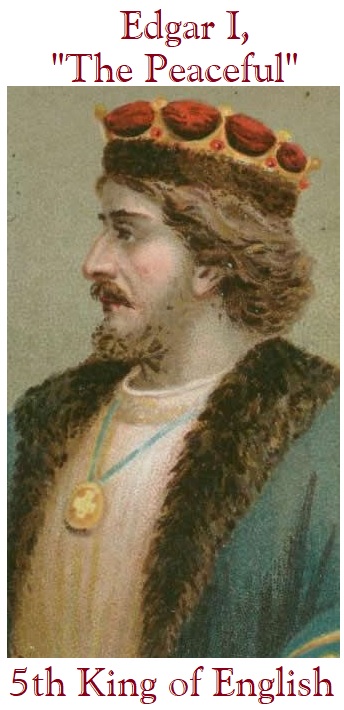
Edgar "the Peaceful" (943 - 08 Jul 975) was King of the English from 959 until his death in 975. The younger son of King Edmund I and Ælfgifu of Shaftesbury, he came to the throne as a teenager. As king, Edgar further consolidated the political unity achieved by his predecessors, with his reign being noted for its relative stability. His most trusted advisor was Dunstan, whom he recalled from exile and made Archbishop of Canterbury. The pinnacle of Edgar's reign was his coronation at Bath in 973. Edgar was crowned at Bath and along with his wife Ælfthryth was anointed, setting a precedent for a coronation of a queen in England itself; and forms the basis for the current coronation ceremony. By the end of his reign, England was sufficiently unified that it was unlikely to regress back to a state of division among rival kingships. Edgar died on 8 July 975 at Winchester, Hampshire. He was buried at Glastonbury Abbey.
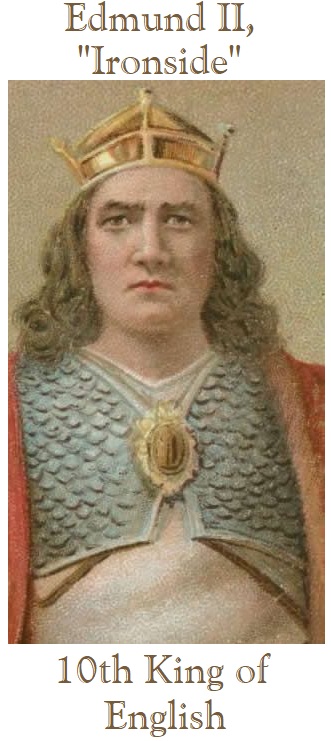
Edmund II "Ironside" (990 - 30 Nov 1016) was King of the English from 23 April until 30 November 1016. He was the son of King Æthelred the Unready and his first wife, Ælfgifu of York. Edmund's reign was marred by a war he had inherited from his father; his cognomen "Ironside" was given to him "because of his valour" in resisting the Danish invasion. Edmund was not expected to be King of England; however, by June 1014 two elder brothers had died, making him heir apparent. Æthelred died on 23 April 1016, and the citizens and councillors in London chose Edmund as king. Edmund then mounted a last-ditch effort to revive the defense of England. While the Danes laid siege to London, Edmund headed for Wessex, where the people submitted to him and he gathered an army. He fought inconclusive battles against the Danes and their English supporters at Penselwood in Somerset and Sherston in Wiltshire. He then raised the siege of London, which had been successfully resisted by the citizens, and defeated the Danes near Brentford. They renewed the siege while Edmund went to Wessex to raise further troops, returning to again relieve London, defeat the Danes at Otford, and pursue Cnut into Kent. On 30 November 1016, Edmund died. The location of his death is uncertain, though it is generally accepted that it occurred in London. Edmund was buried near his grandfather King Edgar the Peaceful at Glastonbury Abbey in Somerset. the intensity of Edmund's struggle against the Danes in 1016 is only matched by Alfred the Great's in 871, and contrasts with Æthelred's failure. Edmund's success in raising one army after another suggests that there was little wrong with the organs of government under competent leadership. He was "probably a highly determined, skilled and indeed inspiring leader of men". Cnut visited his tomb on the anniversary of his death and laid a cloak decorated with peacocks on it to assist in his salvation, peacocks symbolizing resurrection.
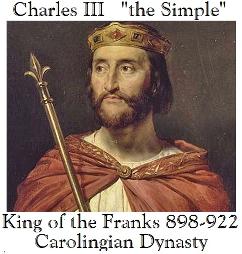
Charles III (17 Sep 929 - 07 Oct 929) - called Charles the Simple or the Straightforward was King of West Francia from 898 until 922 and the King of Lotharingia from 911 until 919–923. He was a member of the Carolingian dynasty. In 893, at the age of 14, Charles was crowned by a faction opposed to the rule of Odo at the Reims Cathedral, becoming monarch of West Francia only after the death of Odo in 898. In 911, a group of Vikings led by Rollo besieged Paris and Chartres. After a victory near Chartres on 26 August, Charles decided to negotiate with Rollo, resulting in the Treaty of Saint-Clair-sur-Epte which created the Duchy of Normandy. In return for the Vikings' loyalty, they were granted all the land between the river Epte and the sea, as well as Duchy of Brittany.
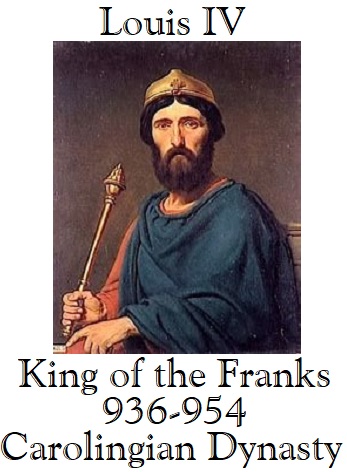
Louis IV (10 Sep 920 - 30 Sep 954) - called d'Outremer or Transmarinus (both meaning "from overseas"), reigned as King of West Francia from 936 to 954. A member of the Carolingian dynasty, he was the only son of king Charles the Simple and his second wife Eadgifu of Wessex, daughter of King Edward the Elder of Wessex. He was descended both from Charlemagne and King Alfred the Great. Louis became the heir to the western branch of the Carolingian dynasty after the death of his captive father in 929, and in 936, at the age of 15, was recalled from Wessex by the powerful Hugh the Great, margrave of Neustria, to succeed the Robertian King Rudolph who had died. Louis IV was crowned king by Archbishop Artald of Reims on Sunday, 19 June 936, probably at the Abbey of Notre-Dame and Saint-Jean in Laon.
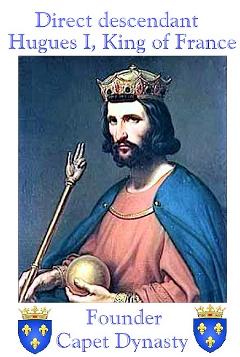
Hugues I (939 - 14 Oct 996) was the King of the Franks from 987 to 996. He is the founder and first king from the House of Capet. The son of the powerful duke Hugh the Great and his wife Hedwige of Saxony, he was elected as the successor of the last Carolingian king, Louis V. Hugh was descended from Charlemagne's sons Louis the Pious and Pepin of Italy through his mother and paternal grandmother, respectively, and was also a nephew of Otto the Great. The dynasty he founded ruled France for nearly three and a half centuries from 987 to 1328 in the senior line, and until 1848 via cadet branch. Hugh Capet died on 14 October 996 in Paris, and was interred in the Saint Denis Basilica. His son Robert continued to reign. Most historians regard the beginnings of modern France as having initiated with the coronation of Hugh Capet. This is because, as Count of Paris, he made the city his power centre. The monarch began a long process of exerting control of the rest of the country from there. All French kings through Louis Philippe, and all royals since then, have belonged to the dynasty. Philip II was the first to use the title 'King of France'. Furthermore, cadet branches of the House continue to reign in Spain and Luxembourg.

Robert II (972 - 20 Jul 1031) called "the Pious" or "the Wise" was King of the Franks from 996 to 1031, the second from the Capetian dynasty. Crowned Junior King in 987, he assisted his father on military matters (notably during the two sieges of Laon, in 988 and 991). Robert II distinguished himself with an extraordinarily long reign for the time. His 35-year-long reign was marked by his attempts to expand the royal domain by any means, especially by his long struggle to gain the Duchy of Burgundy (which ended in 1014 with his victory) after the death in 1002 without male descendants of his paternal uncle Duke Henry I.
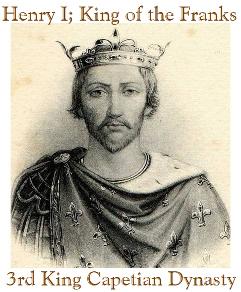
Henry I (04 May 1008 - 04 Aug 1060) was King of the Franks from 1031 to 1060. The royal demesne of France reached its smallest size during his reign. In the early-Capetian tradition, he was crowned King of France at the Cathedral of Reims on 14 May 1027, while his father still lived. He had little influence and power until he became sole ruler on his father's death 4 years later. In an early strategic move, Henry came to the rescue of his very young nephew-in-law, the newly appointed Duke William of Normandy (who would go on to become William the Conqueror), to suppress a revolt by William's vassals.

Lady Godiva (in old English Godgifu) - was a late Anglo-Saxon noblewoman who is relatively well documented as the wife of Leofric, Earl of Mercia, and a patron of various churches and monasteries. Today, she is mainly remembered for a legend dating back to at least the 13th century, in which she rode naked – covered only in her long hair – through the streets of Coventry. Both Leofric and Godiva were generous benefactors to religious houses. In 1043, Leofric founded and endowed a Benedictine monastery at Coventry on the site of a nunnery destroyed by the Danes in 1016. Writing in the 12th century, Roger of Wendover credits Godiva as the persuasive force behind this act. Lady Godiva took pity on the people of Coventry, who were suffering grievously under her husband's oppressive taxation. Lady Godiva appealed again and again to her husband, who obstinately refused to lower the taxes. At last, weary of her entreaties, he said he would grant her request if she would strip naked and ride on a horse through the streets of the town. Lady Godiva took him at his word, and after issuing a proclamation that all persons should stay indoors and shut their windows, she rode through the town, clothed only in her long hair.
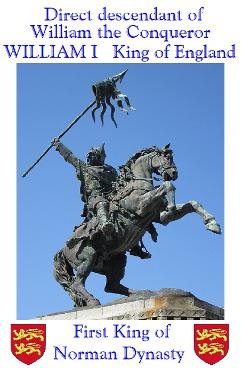
William I; usually known as William the Conqueror and sometimes William the Bastard, was the first Norman King of England, reigning from 1066 until his death in 1087. A descendant of Rollo, he was Duke of Normandy from 1035 onward. By 1060, following a long struggle to establish his throne, his hold on Normandy was secure. In 1066, following the death of Edward the Confessor, William invaded England, leading an army of Normans to victory over the Anglo-Saxon forces of Harold Godwinson at the Battle of Hastings. William was the son of the unmarried Duke Robert I of Normandy and his mistress Herleva. His illegitimate status and his youth caused some difficulties for him after he succeeded his father. William was crowned king on Christmas Day, 1066, in London. He made arrangements for the governance of England in early 1067 before returning to Normandy. He died in September 1087 while leading a campaign in northern France, and was buried in Caen. His reign in England was marked by the construction of castles, settling a new Norman nobility on the land, and change in the composition of the English clergy.
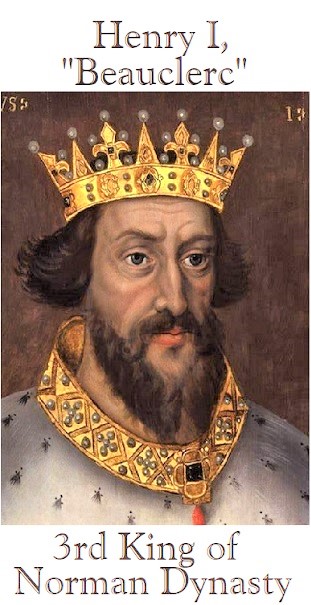
Henry I; Beauclerc - (1068 - 01 Dec 1135) - was King of England from 1100 to his death in 1135. He was the fourth son of William the Conqueror and was educated in Latin and the liberal arts. On William's death in 1087, Henry's elder brothers Robert Curthose and William Rufus inherited Normandy and England, respectively, but Henry was left landless. Present at the place where his brother William died in a hunting accident in 1100, Henry seized the English throne, promising at his coronation to correct many of William's less popular policies. He married Matilda of Scotland and they had two surviving children, William Adelin and Empress Matilda; he also had many illegitimate children by his many mistresses. Robert, who invaded in 1101, disputed Henry's control of England; this military campaign ended in a negotiated settlement that confirmed Henry as king. The peace was short-lived, and Henry invaded the Duchy of Normandy in 1105 and 1106, finally defeating Robert at the Battle of Tinchebray. Henry kept Robert imprisoned for the rest of his life. Henry's son William drowned in the White Ship disaster of 1120, throwing the royal succession into doubt. Henry took a second wife, Adeliza of Louvain, in the hope of having another son, but their marriage was childless. Henry died on 1 December 1135 after a week of illness. The King was succeeded by his nephew Stephen of Blois, resulting in a period of civil war known as the Anarchy.
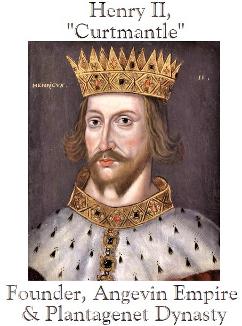
Henry II; "Curtmantle"; Founder Angevin Empire and Plantagenet Dynasty (5 March 1133 – 6 July 1189), also known as Henry Curtmantle. was King of England from 1154 until his death in 1189. Henry's mother was the eldest daughter of Henry I, King of England and Duke of Normandy. She was born into a powerful ruling class of Normans, who traditionally owned extensive estates in both England and Normandy, and her first husband had been the Holy Roman Emperor Henry V. He was the first king of the House of Plantagenet. King Louis VII of France made him Duke of Normandy in 1150. Henry became Count of Anjou and Maine upon the death of his father, Count Geoffrey V, in 1151. He became Count of Nantes by treaty in 1158. Before he was 40, he controlled England, large parts of Wales, the eastern half of Ireland and the western half of France; an area that was later called the Angevin Empire. At various times, Henry also partially controlled Scotland and the Duchy of Brittany. Henry was an energetic and ruthless ruler; but not vindictive, driven by a desire to restore the lands and privileges of his grandfather Henry I. During the early years of his reign the younger Henry restored the royal administration in England, re-established hegemony over Wales and gained full control over his lands in Anjou, Maine and Touraine. Henry also had concern for ordinary people, ordaining early in his reign that those shipwrecked should be well-treated and prescribed heavy penalties for anyone who plundered their goods. Ralph of Diceto records that when a famine struck Anjou and Maine in 1176, Henry emptied his private stores to relieve distress among the poor. Henry had a tumultuous relationship as King Henry grew older; and finally descended into violence shortly before Henry's death. The papacy intervened to try to produce a last-minute peace deal, but by now Henry was suffering from a bleeding ulcer that ultimately proved fatal. Henry was buried at the nearby Fontevraud Abbey.