Generation 42
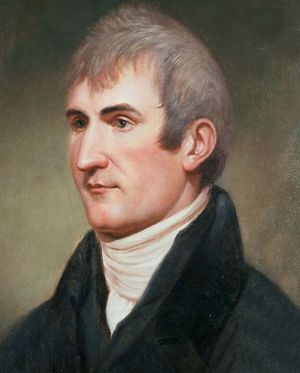
HUSBAND Meriwether LEWIS
Born 18 Aug 1774 in Locust Hill; Albemarle; VA
Married see NOTES in
Died 11 Oct 1809 in Grinders Stand; Lewis; TN
Burial
Father William LEWIS
Mother Lucy MERIWETHER
WIFE Winona
Born in
Died in
Burial
Father
Mother
CHILDREN
1 Male Joseph DeSmet LEWIS
Born 1805 in
Married in
Died 1889 in
Burial
Spouse Annie TAMAKOCE
NOTES
Meriwether Lewis was not known to have married (though he apparently considered it at one point). However, when a Yankton (or possibly Teton) Sioux man and his family presented themselves for baptism, Joseph DeSmet Lewis gave as his place of birth Yankton Agency, his father's name as "Capt. Meriwether Lewis (of Lewis & Clark's Exp.)," and his mother's name as "Winona." This claim and another by a Joseph DeSmet descendant, Martin Charger, are explored in some detail on the Joseph DeSmet Lewis documents. Joseph DeSomet Lewis made somewhat of a name for himself during his lifetime. With Jim Bridger, he guided and hunted for the U.S. Army Warren surveys between 1855 and 1857. Lt. Warren's assistant wrote in 1856 that Lewis was 'a hunter (a half-breed Sioux) who says that his father was Meriwether Lewis.
Meriwether Lewis was a soldier, public administrator, and famed explorer as co-leader of the Corps of Discovery, commonly referred to as the Lewis and Clark Expedition. Meriwether's father, who served in the Continental Army, died from pneumonia after his horse fell into an icy stream in 1779.
Six months later, his mother married another Army officer, Captain John Marks, who managed a 1,000 acre plantation about 10 miles from Monticello, Thomas Jefferson's home. Marks raised Meriwether and his two siblings along with his own two children with Lucy, John Hastings Marks and Mary Garland (Marks) Moore.
The new family soon moved to Georgia and Meriwether spent his time learning outdoorsman skills. He also showed an interest in plant knowledge, and his mother, an herbalist, encouraged that interest. These combined skills would later be useful in his expeditions. About the age of 13 he returned to Virginia and to the household of his uncle Nicholas Lewis, his formal education beginning at this time. In 1793, Lewis graduated from Liberty Hall (now Washington and Lee University).
Lewis joined the Army in 1794 and spent six years in the militia, serving during the "Whiskey Rebellion". It was during this time in the Army that he met William Clark for the first time. In April 1801, he was appointed personal secretary to President Thomas Jefferson. Jefferson had mentored Meriwether in his youth and was a friend, as well as appreciative of Meriwether's unique skills.
It was at Jefferson's suggestion that the Corps of Discovery expedition was undertaken and the plan was approved by Congress in 1803. The mission of the Corps was to explore the territory of the Louisiana Purchase, establish trade and sovereignty over the natives near the Missouri River, and claim the Pacific Northwest and Oregon territory for the United States before European nations. Meriwether needed someone else to help him lead the expedition. Both President Jefferson and Meriwether showed support in adding William Clark to the group, the president offering Lewis and Clark both a permanent rank of Captain as part of his proposal. Clark graciously accepted.
In addition to his role as naturalist, Meriwether also served to represent the new government, which had purchased the area, to the native peoples living there. The trip had many perilous moments for Meriwether; who managed to survive falls, gun shot wounds, and accidental poisoning. The group returned to St. Louis in 1806 to start reporting their findings and accomplishments. After returning from the expedition, Lewis's life had the potential to become that of a politician and stateman, and in 1807 President Jefferson appointed him as Governor of the Louisiana Territory.
However, his life degraded, and started drinking excessively, which negatively affected his relationship with Jefferson.
Lewis died at a Natchez Trace inn, in what was either a murder or suicide. The exact details of his death have never been learned because the early morning events were not directly witnessed by anyone. Lewis died and was buried near the Grinder's Stand roadhouse (modern Hoenwald, Lewis Co., TN) on the Natchez Trace, October 11, 1809. A monument erected in 1848 now stands in his honor near the place the tavern occupied, and is under the care of the National Parks Service.