Generation 41
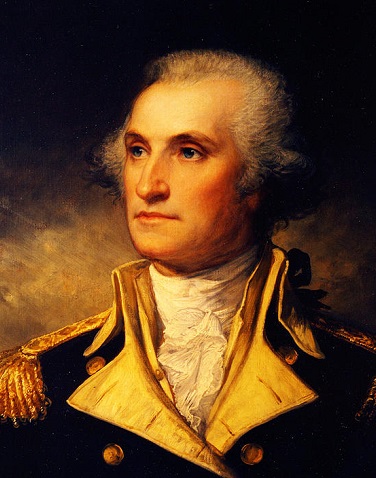
George Washington
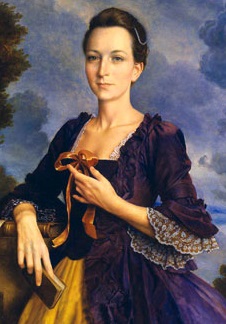
Martha Washington
HUSBAND George Eskridge WASHINGTON First President of the United States
Born 22 Feb 1732 in Pope's Creek; Westmoreland; VA
Married 06 Jan 1759 in St Peter's Church; New Kent; VA
Died 14 Dec 1799 in Mount Vernon; Fairfax; VA
Burial Mount Vernon; Fairfax; VA
Father Captain Augustine WASHINGTON
Mother Mary BALL
WIFE Martha DANDRIDGE - CUSTIS First Lady
Born 21 Jan 1731 in Chestnut Grove; New Kent; VA
Died 22 May 1802 in Mount Vernon; Fairfax; VA
Burial Mount Vernon; Fairfax; VA
Father John GANDRIDGE II
Mother Frances Orlando JONES
CHILDREN
None
NOTES
First off George and Martha had no children of their own. Martha had been married previously and George treated them as his own.
Lets step back and look at the early years of Martha. She was born Marth Dandridge. In her late teens, Martha Dandridge caught the eye of Daniel Parke Custis (1711-1757), who, though twenty years her senior, was one of the most eligible bachelors in Virginia. Daniel’s father initially opposed the marriage, because the prospective bride’s family was not as wealthy as he would have liked. He finally gave his consent after meeting Martha Dandridge, telling friends that he was “as much enamored with her character as [his son was] with her person.” Soon after they married on May 15, 1750, Martha moved into Daniel Parke Custis’s home, called White House, on the Pamunkey River in New Kent County, Virginia. The death of Custis’s father the previous November meant that Daniel Parke Custis had become one of the wealthiest men in Virginia.
Like Martha’s father, Custis exported tobacco. Unlike her father, the size of his holdings was immense. His wealth consisted of almost three hundred slaves and over 17,500 acres of land scattered in six different counties. Martha’s move into White House not only signaled a shift from maidenhood into marriage but also her ascension into the highest echelon of Virginia society. Taking advantage of a plethora of new consumer goods available from Britain, Martha Custis furnished her house with the finest objects money could buy: damask fabric to cover the dining room chairs; elaborate tea sets; beautiful Chinese export porcelain; and sterling silver flatware engraved with the Custis coat-of-arms. It was perhaps in her role as a mother that Martha Custis found the most joy as well as the most sorrow. Soon after her marriage, she became a mother herself. Martha Custis’s first child was a son, named Daniel Parke Custis, born on November 19, 1751, followed in April 1753 by a daughter, Frances Parke Custis. Although the first names were traditional family names, the children’s great-grandfather had imposed a strict condition on inheritance: only children bearing the name “Parke” as part of their given name would receive a portion of the family estate. Despite their distinguished lineage, neither Daniel nor Frances would reach the age of five. In the colonial era, childhood was the period of greatest vulnerability to death and disease. In 1754 Daniel died, probably of malaria; Frances died in 1757.
Yet in the meantime, Martha Custis had given birth to two more children who would become the center of her own life: John Parke Custis (called “Jacky”), who was born in 1754, and Martha Parke Custis (called “Patsy”), born in 1756. Martha may well have been on track to have as many children as her mother when an unforeseen tragedy intervened. Just a few months after their daughter Frances had died, Daniel Parke Custis suddenly became ill. Although Martha Custis summoned the best physicians money could buy, her husband died on July 8, 1757. By all accounts, their seven-year marriage had been a happy one. Now, however, at the tender age of twenty-six, Martha Dandridge Custis was left alone in the world, a widow with two small children to raise.
As a young, attractive, wealthy widow, Martha Dandridge Custis probably enjoyed more freedom to choose her own destiny than at any other point in her life. She was only twenty-six years old, owned nearly 300 enslaved individuals and had more than 17,500 acres of land— worth more than £40,000. Because her husband had died without a will, she was the executor of his estate. Freed from the strictures of coverture, she had many of the same legal rights as men: she could buy and sell property, make contracts, sue and be sued in court. As a result, grief-stricken though she was, Martha was willing to consider the possibility of remarriage within a relatively short time after Daniel Parke Custis’s death.
One of those who undoubtedly heard about her availability was a young military man named George Washington. Born on February 22, 1732, Washington had grown up in a modestly prosperous Virginia family who lived on a plantation near Fredericksburg. Little is known of George Washington's childhood, and it remains the most poorly understood part of his life. His early experiences working as a surveyor and in the Virginia company helped shape him as a person. The unexpected death of their father, when George Washington was eleven, prevented him from receiving a Latin-based education at Appleby School in England as his brothers had. Instead, private tutors and possibly a local school in Fredericksburg provided the young man with the only formal instruction he would receive. In addition to reading, writing, and basic legal forms, Washington studied geometry and trigonometry—in preparation for his first career as a surveyor—and manners—which would shape his character and conduct for the rest of his life.
After much training; Washington executed his first practice surveys, and in 1749 he secured the lucrative office of county surveyor in Culpeper County, Virginia. The war stories told by his half-brother, Lawrence Washington, an officer in the Virginia militia likely ignited Washington’s interest in a military career, but printed histories may have also inspired him. As commander of the Virginia Regiment during the French and Indian War (1755–1758) and later as commander-in-chief of the Continental Army (1775–1783), Washington took a studious approach to war and urged his men to do likewise. He instructed his officers, both in his official orders and private letters, to study military treatises. When morale was low, he deployed the powerful words of pamphleteers and playwrights to buoy the army’s spirits and rekindle their commitment to the cause. At critical points throughout his military career, George Washington found inspiration and encouragement in historical, political, and poetic writings. When he was discouraged by defeats suffered in the French and Indian War, he looked to the heroic examples of Alexander the Great and Julius Caesar. Later, when rations, pay, and supplies were scarce during the Revolution, Washington ordered Thomas Paine’s stirring manifesto, The Crisis, read to the troops. And when news of the French alliance arrived after the harsh winter at Valley Forge, he celebrated with the performance of Cato, a popular play that embodied the struggle against tyranny. In both the French and Indian War and the American Revolution, George Washington faced the frustrating task of transforming liberty-loving colonists into disciplined soldiers. Officers were often as unfamiliar with the basic commands as their troops, and Washington urged them to read military manuals. One Hessian soldier recalled with surprise the books found in the captured bags of American officers: “This was a true indication that the officers of this army studied the art of war while in camp.”
FRENCH and INDIAN WAR
In 1753, Lieutenant Governor Dinwiddie of Virginia ordered a young, ambitious 21-year old George Washington on a mission deep into the Ohio Country to confront the French. Following this skirmish at Jumonville Glen, Washington immediately returned to Great Meadows and began fortifying Fort Necessity in anticipation of fierce French retaliation. The French would indeed strike back on the morning of July 3, with a force of 500 men and 100 Indians appearing in the tree-line around Fort Necessity. The fight devolved into a standoff in a torrential downpour throughout the afternoon, with both sides sustaining significant casualties. With soaking gunpowder and a fighting force with low morale, Washington negotiated and accepted terms of capitulation in the late evening on July 3, surrendering his swivel guns, but maintaining the rest of his equipment. On July 4, a date he could not have expected to celebrate one day, Washington’s depleted force departed Fort Necessity in defeat. The account of his journey to Fort Le Beouf and back made Major Washington a celebrity on both sides of the Atlantic. In 1754 Washington’s surprise attack upon a small French force at Jumonville Glen and his subsequent surrender to French forces at the Battle of Fort Necessity helped to spark the French and Indian War, which was part of the imperial conflict between Great Britain and France known as the Seven Years’ War. During the French and Indian War, Washington learned many important military lessons that he would incorporate into the American Revolution.
On March 1758, during an interlude in the fighting, Washington traveled for a visit to Williamsburg, a place where the colony’s leading men gathered during meetings of the House of Burgesses. Hearing the news about the Custis widow, he contemplated his own future and turned his mind to his marriage prospects. Traveling the thirty-five miles from Williamsburg to Martha’s home, George paid a visit to Martha Dandridge Custis on March 16, 1758. After returning for another visit on March 25, Washington returned to his military post.
Within months of these meetings, both parties began to plan a future together. Washington began renovating and improving his home at Mount Vernon. Martha placed an order for wedding finery from London, a shipment that included brilliant purple slippers and a dress that was to be “grave but not Extravagent nor to be mourning,” one perfect for a bride in her situation. Their attraction was mutual, powerful, and immediate. Martha was charming, accomplished, and, of course, wealthy. George had his own appeal. Over six foot two inches tall (compared with Martha, who was only five feet tall), George was an imposing figure whose reputation as a military leader preceded him. Like his future wife, Washington’s own social status had improved as a result of an unfortunate death. After his half-brother Lawrence and his widow died, Washington would inherit Mount Vernon, a beautiful 2000-acre estate located high above the Potomac River in Northern Virginia. At the end of 1758, Washington resigned his military commission. On January 6, 1759, Martha Dandridge Custis married George Washington at her home in New Kent County. For both Martha and for George, a new era had dawned.
REVOLUNTIONARY WAR
Despite having little practical experience in managing large, conventional armies, Washington proved to be a capable and resilient leader of the American military forces during the Revolutionary War. While there were over 230 skirmishes and battles fought during the American Revolution, below are some of the battles General Washington was present for.
Boston was a city under British occupation as a result of the conflicts at Lexington and Concord. By the time George Washington took command of the Continental Army on July 3rd, the British had also seized Bunker and Breed's Hills. Washington set about transforming his untrained force of farmers and private citizens into an effective fighting force.
In November 1775, Henry Knox arrived at Washington's camp bringing cannons captured at Fort Ticonderoga, nearly 500 miles away. Washington placed the cannons atop Dorchester Heights, within range of the British fleet and Boston. When the British commander, General William Howe, realized that this maneuver threatened his fleet and the safety of his troops in Boston, he evacuated the city and retreated to Halifax, Nova Scotia.
Following the successful siege of Boston, George Washington knew that it was only a matter of time before the British returned with more men, and he was certain that General Howe's objective would be the city of New York. Washington was correct, and in early July, the largest British fleet ever assembled to that point landed 32,000 men on Staten Island. While Washington strengthened his positions in lower Manhattan, he also fortified Brooklyn Heights, across the East River on Long Island. It was there, on August 27, 1776, that Howe landed his troops and succeeded in flanking the American position through the unguarded Jamaica Pass. While soundly defeated, Washington was able to execute a nighttime evacuation of Long Island that saved close to 9,000 troops.
Having abandoned New York, George Washington joined his troops along a new defensive line at Harlem Heights on September 16, 1776. Soon after he arrived, this position was tested by an advanced detachment of Howe's forces. Although the Continentals were initially pushed back, reinforcements and a flank attack ordered by Washington resulted in a British retreat and Washington's first battlefield victory of the American Revolution.
After a string of defeats in New York, George Washington led his troops in a retreat through New Jersey, and across the Delaware River into Pennsylvania. There, he faced dwindling supplies, desertion, and expiring enlistments. Realizing that his army desperately needed a victory, Washington planned for a nighttime crossing of the Delaware River in order to attack a Hessian garrison in the town of Trenton, New Jersey. Following a night of misery crossing the Delaware River in the midst of a winter storm, Washington's troops were in position to attack Trenton just after 8:00am. Caught completely by surprise, the Hessian garrison put up a brief fight before surrendering.
After taking the offensive during the Trenton-Princeton campaign, George Washington shifted to a defensive strategy aimed at preserving his army and destroying resources desperately needed by his opponents. Known as the Forage War, this period was noted for several small engagements in which Washington's troops attempted to keep British soldiers from securing hay for horses and livestock, in addition to other provisions. Although it consisted of small battles and skirmishes, casualties could still be high. After his defeat at Brandywine and the British capture of Philadelphia, George Washington was looking for an opportunity to strike back at General William Howe's forces. He would have his chance in early October, when Howe divided his army and encamped at Germantown, seven miles northeast of Philadelphia, with 9,000 troops. On the night of October 3, 1777, Washington's troops set out on a 16-mile march that he hoped would result in a coordinated attack on the Germantown encampment by four converging columns. Although initially successful in surprising Howe and pushing his forces back, late arrivals by Washington's flanking columns and stubborn resistance from British soldiers trapped in Cliveden, a mansion they occupied in the rear of the American forces, resulted in an eventual victory for Howe.
Between 1778 and 1781, after the British withdrawal from Philadelphia, George Washington placed his army outside of New York and waited for an opportunity to attack the forces of General Sir Henry Clinton while the British waged a largely successful campaign across the south. Late in the summer of 1781, the British, specifically Lord Cornwallis, finally made the mistake Washington had been waiting for. Cornwallis entrenched his army around Yorktown, Virginia, where he waited for either reinforcement from Clinton or evacuation to New York. Washington quickly moved south with his French allies and coordinated with the Marquis de Lafayette to keep Cornwallis in place. At the same time, French naval forces maintained control over access to the Chesapeake Bay, which prevented naval assistance and reinforcements from reaching Yorktown. Washington's southward journey included a visit to his beloved Mount Vernon, his first since the war began six years earlier, before arriving outside Yorktown to supervise the construction of the Franco-American lines. Washington himself fired the first American cannon of the siege. The capture of key portions of the British entrenchments, and the opening of a second allied siege line signaled the end for Cornwallis, who formally surrendered on October 19, 1781. The surrender of over 7,000 British troops on October 19, 1781 did not end the war. The end came in 1783 after Washington moved back to New York City, with the Peace of Paris signed by a British government installed largely as a result of Washington's victory.
George Washington is the only US president to have never occupied the White House. In New York and then later in Philadelphia, the Washingtons occupied a series of grand houses, where they received members of Congress, officials, foreign dignitaries, and other prominent people according to a standing weekly schedule. In July 1790, Congress passed the Residence Act which called for the permanent capital of the United States to be located on the Potomac River (the future Washington D.C.). President Washington personally overlooked the building of what he once termed "the seat of Empire." He specified the location of the ten-mile square federal district, the President's mansion (the White House), and the Capitol.
Two centuries ago, citizens of the new United States were quite uncertain of the outcome during the first election in 1789. Everyone expected George Washington to win the election, but an equally important question remained unanswered: would he accept the job? But Washington did not place his name in nomination, did absolutely no public campaigning, and even cast doubt on whether he would take the job if elected. Washington's acceptance was by no means a sure thing. The retired general said that he had "no wish which aspires beyond the humble and happy lot of living and dying a private citizen" at his Mount Vernon farm.
Washington was sequestered at Mount Vernon on February 4, 1789, as 69 state electors--some selected by voters, some appointed by state legislatures and some by governors--gathered in their home states to cast their votes. Each was required to cast one vote for the first President of the United states and a second for the Vice President. The stakes were high--America needed a strong and effective leader as soon as possible. Fortunately, when the votes were tallied, George Washington was elected unanimously and he still ranks as the only President to receive every vote; not just once, but twice. Upon learning he had been elected unanimously; he made the following statement.
"I have been long accustomed to entertain so great a respect for the opinion of my fellow-citizens, that the knowledge of their unanimous suffrages having been given in my favor, scarcely leaves me... an option. Whatever may have been my private feelings and sentiments, I believe I cannot give a greater evidence of my sensibility for the honor they have done me, than by accepting the appointment... All I can promise is; only that which can be accomplished by an honest zeal."
At Washington's inauguration, A military salute is fired by artillery at nearby Fort George and throughout New York City, church bells ring for half an hour. Among hundreds of citizens awaiting the ceremony were both houses of Congress, American officials and New York state notables, and diplomats from France and Spain. The oath would be administered by the Chancellor of the state of New York, Robert Livingston on the gallery balcony outside the Senate Chamber so “that the greatest number of the people of the United States, and without distinction, may be witnesses to the solemnity”.
A military escort arrives at Franklin House to conduct the president-elect to Federal Hall. The full ceremonial procession includes Grand Marshall Colonel Morgan Lewis and a military contingent of 500 men, including a troop of horse, artillery, two companies of Grenadiers, a company of light infantry, and a company of Scottish Highlanders in traditional garb. Washington himself traveled in a state coach with his two aides, escorted by the Senate Committee, Committee of the House, Chancellor Robert Livingston, the French and Spanish ministers, and a multitude of ordinary citizens. Upon arriving at Federal Hall, Washington proceeds to the Senate chamber where the two houses of Congress awaited their new head of state and is formally welcomed by John Adams, his vice president.
Washington took the oath with his hand on the Bible, and kissed the Bible after taking the oath. From the portico overlooking Wall and Broad Streets, Livingston turned to the teeming streets below and shouted, "Long live George Washington, President of the United States!"
The new president bowed to the crowd, and then retired to the Senate chamber where he would deliver his inaugural address.